
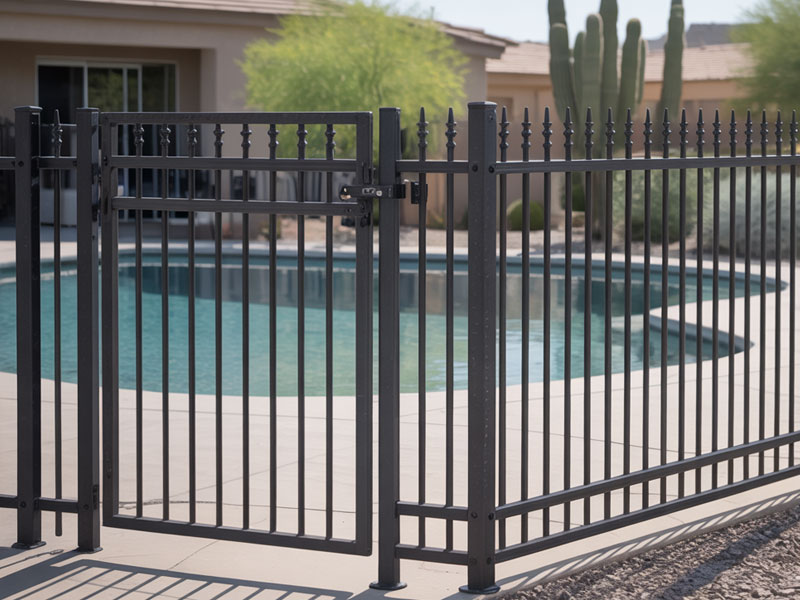
Arizona Pool Fence Laws Explained for Mesa Homeowners 2026
Arizona recorded 36 child drowning deaths in 2024, and 75 percent of them happened in residential pools, spas, and hot tubs. That number is why Arizona pool fence laws are not suggestions and why Mesa building inspectors take pool barrier compliance seriously.
If you own a pool or spa in Mesa that is 18 inches or more in depth and more than 8 feet wide, Arizona Revised Statutes Section 36-1681 requires a compliant physical barrier around the water.
This guide walks through the specific requirements Mesa homeowners must meet in 2026, including height, gate hardware, opening sizes, and the triggers for an inspection.
Iron FX Welding in Mesa, AZ fabricates and installs pool fencing and gates that meet Mesa’s current code requirements. If your fence needs repair or replacement before a home sale inspection, call 480.900.1540 for a free estimate.
Minimum Height Requirements for Mesa Pool Fences
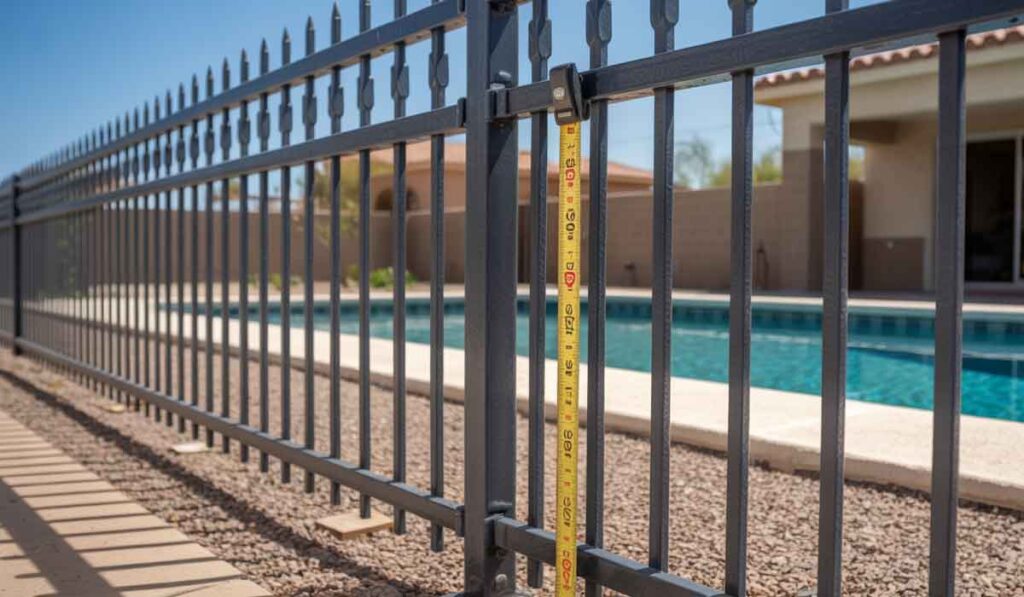
Mesa requires a 5-foot, or 60-inch, barrier height measured from the exterior side of the fence. This is the most common number that gets confused online, where older articles still reference a 48-inch standard. That lower number does not apply in Mesa. Build to 60 inches and measure from the outside of the fence at multiple points around the perimeter.
If your yard slopes, measure at the lowest exterior grade points. A fence that meets 60 inches on flat ground can fall short in a low corner of a sloped lot. Those low spots are exactly where inspectors look first.
The fence height must also remain effective around the full perimeter. Decorative caps, raised planters, retaining walls, and patio furniture placed on the exterior side can reduce the effective height of a compliant fence. Mesa expects the barrier to function at 60 inches regardless of what surrounds it.
When the exterior wall of the house serves as part of the pool barrier, every door and window in that wall needs to meet its own requirements for locks, swing direction, and hardware height. That section is covered below.
Gate Requirements and Hardware Specifications
Most pool fence failures happen at the gate, not the fence panels. The gate hardware weakens faster than the frame, and a gate that passed inspection two years ago may not pass today.
Mesa pool gates must meet all of the following requirements:
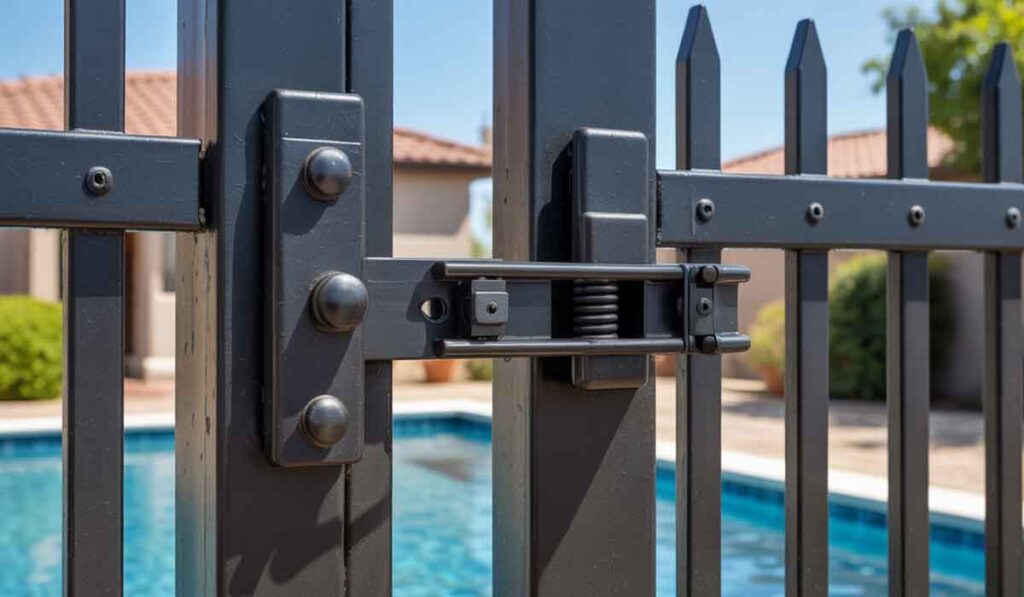
Gate swing direction: Every pedestrian gate must swing away from the pool, opening outward toward the yard rather than inward toward the water.
Self-closing function: The gate must close completely and latch on its own every time. A spring that closes the gate most of the way but relies on a push or slam to engage the latch does not meet code.
Self-latching function: The latch must engage automatically after the gate swings closed. A latch that only catches when the gate is pushed firmly into the frame is a code failure.
Latch height: The release mechanism should be at 54 inches or higher on a pool gate. If the latch sits below 54 inches, the release must be mounted on the pool side of the gate and positioned at least 3 inches below the top rail.
Opening near the latch: Within 18 inches of the release mechanism, no opening in the gate frame can exceed half an inch. This prevents a small hand from reaching through a decorative gap to trip the latch from the outside.
Double gates: One leaf must be fixed in place. The active leaf must be self-closing and self-latching. Two freely swinging leaves on a pool gate is a code failure.
Test your gate by opening it a few inches, halfway, and almost fully. If it does not close and latch on its own from every position, the hardware needs adjustment or replacement before an inspection.
Iron FX Welding in Mesa repairs pool gates including hinge replacement, spring adjustment, latch realignment, and frame straightening. Call 480.900.1540 to schedule a repair before your inspection.
Opening and Spacing Rules
The opening requirements for pool fencing in Mesa are specific and apply to every section of the barrier including fence panels, gates, and decorative elements.
General openings: No opening anywhere in the fence can allow a 4-inch sphere to pass through. Test between every pair of pickets, under each panel, and through any decorative cutout in the design.
Bottom clearance on grass or gravel: Maximum 2 inches between the bottom of the fence and the ground. Ground settling after installation often creates one low spot that opens up beyond 2 inches. Walk the full perimeter after the first monsoon season.
Bottom clearance on concrete: Maximum 4 inches between the bottom of the fence and a concrete deck surface.
Horizontal rails: If horizontal rails are spaced less than 45 inches apart, they must be positioned on the pool side of the vertical pickets. Horizontal members on the exterior side of a fence create footholds that help a child climb.
Wrought iron and ornamental steel: Vertical spacing between pickets must stay at or under 1.75 inches in sections where that requirement applies.
Chain link: Standard residential chain link fencing requires mesh no larger than 1.75 inches and wire weight of 11 gauge or heavier to qualify as a pool barrier. Standard chain link sold at home improvement stores often does not meet this specification without modification.
Diagonal elements and lattice: Openings must stay under 1.75 inches and the angle from vertical cannot exceed 45 degrees. Lattice-style fence sections are one of the most common decorative failures in pool barrier inspections.
A practical field check: carry a tape measure and a 4-inch ball or test block around the full perimeter. Any spot where the ball passes through is a code failure that needs to be corrected before inspection.
Climbing Prevention Requirements
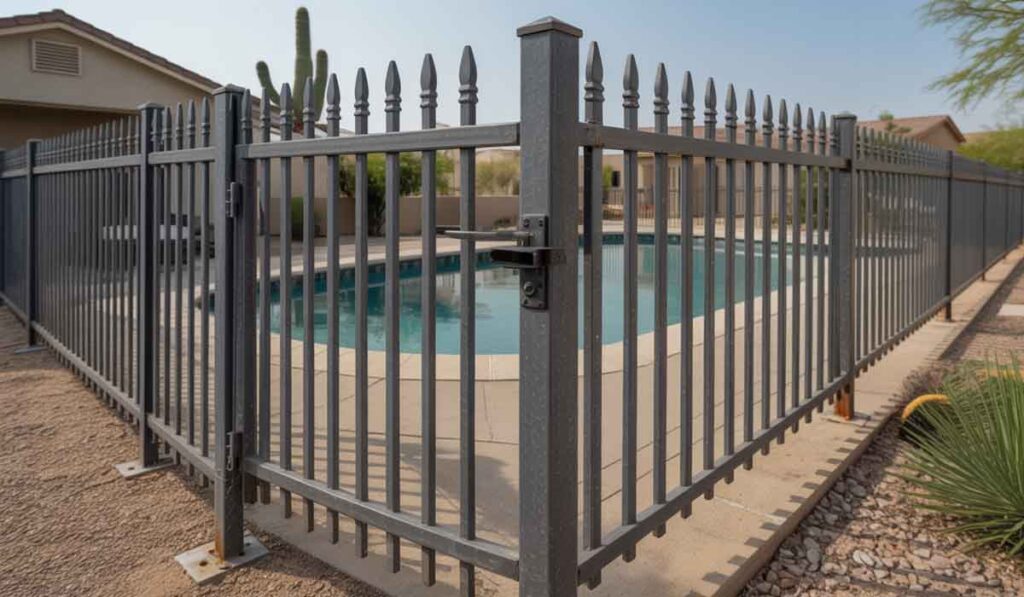
A pool barrier that meets height and opening requirements can still fail if the exterior side allows easy climbing. Mesa requires that the barrier remain hard to climb as well as hard to pass through.
Keep the exterior side of the fence clear of any object that creates a step-up. Patio chairs, storage containers, potted plants, benches, and decorative items placed against the outside of the fence reduce the effective height of the barrier by the height of the object.
Permanent structures and equipment must sit at least 36 inches from the pool barrier. This includes AC condenser pads, pool filter and pump equipment, storage boxes, and built-in planters. Equipment mounted closer than 36 inches gives a child enough of a step to clear a 60-inch fence.
Mesa pool fence mesh systems installed as removable barriers must comply with ASTM F2286. The bottom of a mesh barrier should sit no more than 1 inch above the deck surface to prevent a child from pushing underneath.
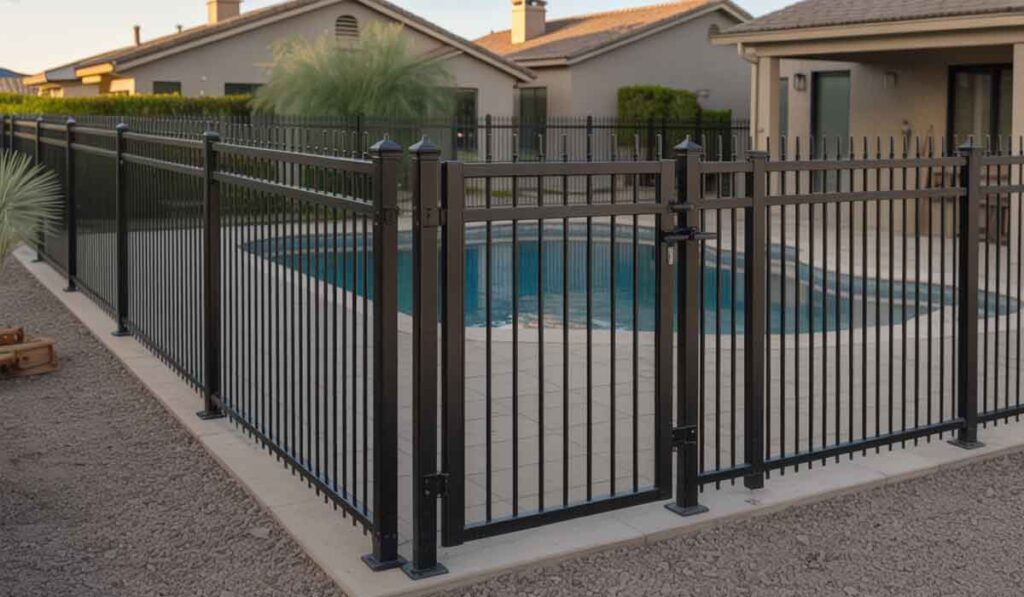
Ornamental iron and steel pool fencing from Iron FX Welding in Mesa is designed with vertical pickets and no horizontal rails on the exterior side, which removes the primary climbing aid on most decorative fence designs. If you are replacing an existing fence that has exterior horizontal rails, that is worth addressing in the new design. Call Iron FX at 480.900.1540 to discuss pool fence design options in Mesa.
When the House Wall Is Part of the Barrier
Many Mesa homes use the rear wall of the house as one side of the pool barrier rather than running a fence panel across the back of the yard. This is allowed, but every door, window, and opening in that wall must meet specific requirements.
Doors: Any door leading from the house directly to the pool area must swing away from the pool, be self-closing, and be self-latching with the release at least 54 inches above the floor. Sliding glass doors do not automatically qualify as pool barrier components. Patio doors that do not self-latch require additional hardware to comply.
Windows: Windows facing the pool area must either have a latch that keeps the window from opening more than 4 inches, a keyed lock, or a screen screwed in place that prevents removal from outside. Standard window screens do not qualify.
Pet doors: Pet doors are not allowed in a wall that serves as a pool barrier component. If your home has a pet door in a wall or door that faces the pool, that wall cannot serve as part of the barrier without blocking or replacing the pet door.
Pool covers: A motorized safety pool cover that meets ASTM F1346 may qualify as an approved barrier component in some configurations. If you are planning to use a pool cover as part of a barrier system, confirm the specific requirements with Mesa’s building department before installation.
Permits and Inspection in Mesa
New pool fence installation in Mesa requires a permit through the City of Mesa Building Safety Division before work begins. Inspections happen after installation. Mesa requires the pool barrier to be inspected and approved before the pool or spa is plastered or filled with water on new construction.
For repair or replacement work on an existing pool fence, contact the City of Mesa Building Safety Division to confirm whether a permit is required based on the scope of the work.
A failed pool fence inspection requires corrections before the project can move forward. Common correction items include gate hardware that does not meet self-closing or self-latching requirements, openings that exceed 4 inches, bottom clearance that exceeds the limit, and low latch positions that expose the release mechanism on the exterior side.
If your pool fence needs to be replaced or repaired to pass inspection, Iron FX Welding in Mesa can assess the existing fence, recommend repairs or replacement, and fabricate new pool fencing that meets Mesa’s current code. Call 480.900.1540 or text a photo of your existing fence for a free estimate.
Penalties for Non-Compliance in Mesa
Mesa requires the pool barrier and all related safety hardware to pass inspection before the pool or spa is put into use. Failing an inspection creates delays and requires corrections and a reinspection before work can continue.
Verified complaints from neighbors or inspectors can bring a code officer to the property. Civil citations and fines can follow a confirmed violation. Ongoing violations may be referred to the City Prosecutor.
Under Arizona Revised Statutes Section 36-1681, a pool barrier violation is classified as a petty offense. The statute allows a homeowner to avoid a fine if the barrier is brought into compliance within 45 days of citation and the owner completes an approved pool safety course.
The practical takeaway is that fixing a bad latch, closing an oversized gap, or repairing a low section of fence before an inspection is always less expensive and less complicated than managing a citation after one.
Frequently Asked Questions — Pool Fence Requirements in Mesa AZ
H3: Does my pool in Mesa need a fence even if I do not have children? Yes. Arizona pool fence requirements under A.R.S. Section 36-1681 apply to the property, not to whether children live in the home. Visiting grandchildren, guests, neighbors, and future buyers all interact with the same backyard. A compliant pool barrier also reduces liability for the property owner in the event of an accident. Iron FX Welding installs and repairs pool fencing for Mesa homeowners with and without children. Call 480.900.1540 for a free estimate.
H3: What is the minimum pool fence height in Mesa AZ? Mesa requires a minimum pool fence height of 60 inches, or 5 feet, measured from the exterior side of the barrier. Some older online sources reference a 48-inch standard. That number does not apply in Mesa. If your current fence is under 60 inches, it will not pass a Mesa pool barrier inspection. Iron FX Welding in Mesa can assess your existing fence height and recommend repair or replacement options. Call 480.900.1540.
H3: How often does a pool gate need to be tested or serviced in Arizona? Mesa does not specify a mandatory service interval for pool gate hardware, but Arizona’s heat and monsoon seasons accelerate wear on springs, latches, and hinges. Iron FX Welding recommends testing your pool gate at least twice per year, once before summer and once after monsoon season. Open the gate at several positions and confirm it closes and latches without assistance every time. If it does not, call 480.900.1540 to schedule a gate hardware repair in Mesa.
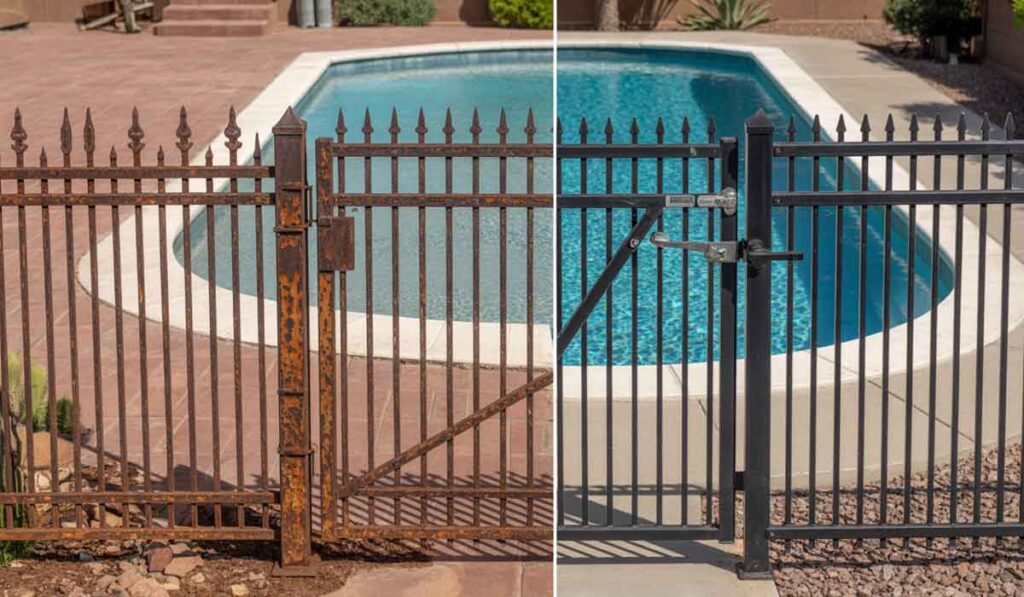
H3: Can I repair my existing pool fence instead of replacing it? In many cases, yes. Common repairs include re-welding cracked frame joints, replacing worn hinge hardware, straightening bent pickets, adjusting gate spring tension, and refinishing sections that have lost their powder coat. If the frame is structurally sound and the picket spacing still meets code, repair is usually more cost-effective than full replacement. Iron FX Welding in Mesa assesses existing pool fencing and gives homeowners an honest recommendation before quoting either option. Call 480.900.1540 for a free assessment.
H3: What does pool fence installation or repair cost in Mesa AZ? Pool fence repair in Mesa typically runs between $200 and $600 depending on the scope of the damage and hardware involved. Full pool fence replacement for a standard residential pool perimeter generally runs from $1,500 to $4,000 depending on linear footage, design, and whether existing posts can be reused. Iron FX Welding provides written quotes with material and labor separated before any work begins. Call 480.900.1540 or text photos of your existing fence to get a free estimate from Iron FX Welding in Mesa.
H3: What pool fence materials hold up best in Arizona’s climate? Powder-coated steel is the most common and cost-effective option for pool fencing in Mesa and the East Valley. For the finish to last in Arizona’s UV conditions, the steel must be sandblasted to bare metal and primed before powder coating is applied. Bare metal or paint applied over rust will fail within two to three years in the Phoenix climate. Aluminum is a rust-free alternative for homeowners in areas with heavy irrigation spray. Iron FX Welding in Mesa uses a full prep process including sandblasting and zinc primer on all exterior pool fencing. Call 480.900.1540 to discuss material options.
If your pool fence in Mesa needs repair, replacement, or inspection before a home sale, Iron FX Welding provides free estimates and written quotes on all pool fencing work throughout Mesa, Gilbert, Chandler, and the East Valley.
Call or text 480.900.1540. Send a photo of your existing fence and we will tell you what it needs before you commit to any work.
Iron FX Welding, Mesa AZ. Licensed and insured. Pool fencing fabricated and installed to current Mesa code requirements.