
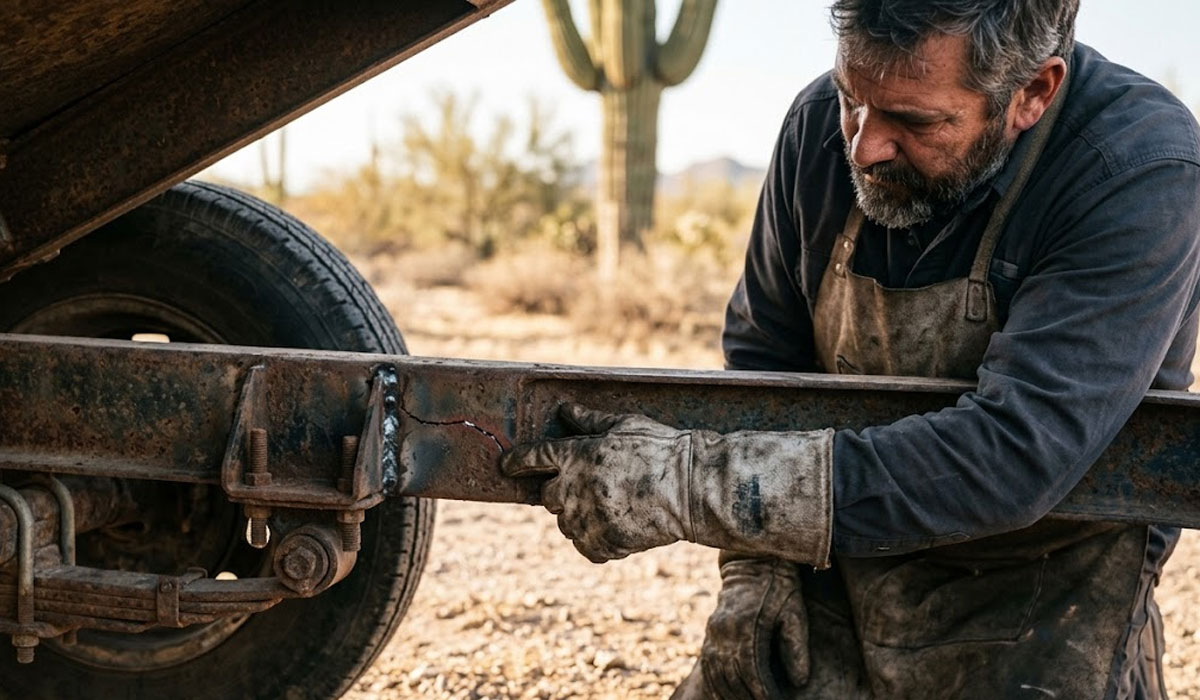
Trailer Frame Cracked? Here’s What a Welder Looks For First
Found a crack in your trailer frame and now you’re asking the big question: is it still safe to tow? That answer matters fast because a crack in the main beam, an axle bracket, or the A-frame changes how the whole trailer carries weight.
At Iron FX Welding, we repair cracked trailer frames across Mesa and the East Valley, and we see the same failure patterns over and over in Arizona.
Before you grab a welder or try to hide the damage under a fresh bead, it helps to understand what a welder actually looks for first.
This guide walks you through the warning signs, the real causes, and what a sound repair involves. If you’d rather have a pro handle it, we cover how to reach us at the end.
The first thing a good welder cares about is structural integrity, not whether the crack can be buried under new weld metal. We want to know where the crack started, what caused it, and whether the steel around it is still strong enough to hold a real repair.
Key Takeaways
- Welders usually start at the crack origin, not the widest opening. The common trouble spots are the frame rail, spring hanger, shackle, axle mounts, crossmembers, and the A-frame.
- Hairline cracks often begin at weld toes, bolt holes, and rust pits. If a crack follows a weld bead, crosses a weld, or bleeds rust, it deserves a closer look.
- Dye penetrant reveals surface cracks, magnetic particle testing works on steel, and ultrasonic testing checks for damage hiding deeper in the joint.
- If the trailer pulls, clunks, leans, or shows uneven tire wear, a welder checks alignment, spring hangers, and axle position before touching a torch.
- Good repairs fix the cause, not just the crack. That can mean removing bad weld metal, straightening misaligned parts, adding reinforcement, and using the right process for the frame material.
Common Signs of a Cracked Trailer Frame
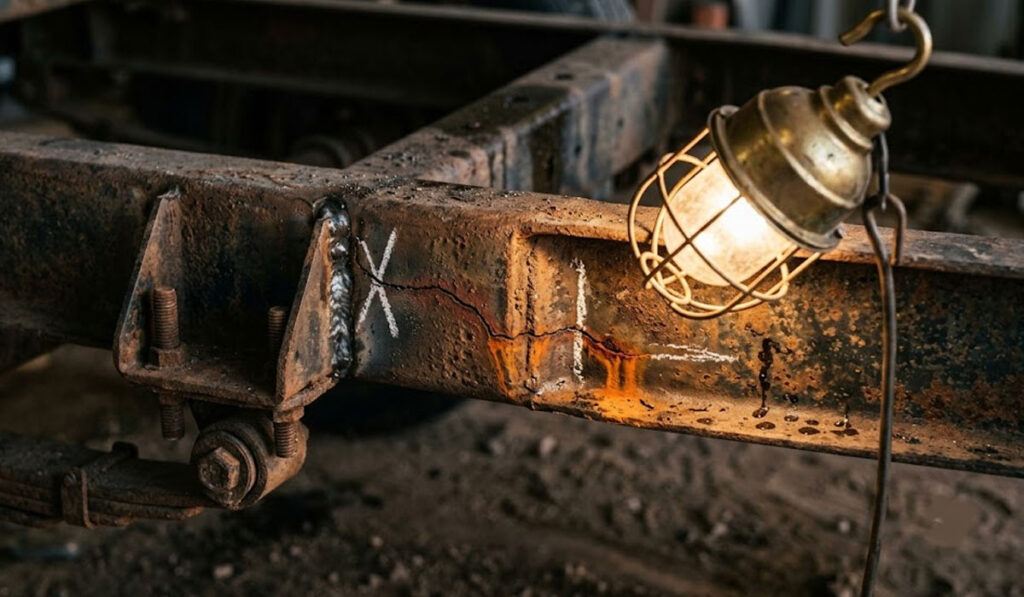
Some damage is easy to spot. Some show up as a strange noise, crooked tracking, or tire wear that keeps coming back. A welder usually starts with the obvious signs, then works backward to the point that failed first.
On most utility, cargo, dump, and equipment trailers, that means checking the main beam, the c-channel, crossmembers, spring hangers, and the area around the coupler.
Visible cracks or fractures. Start with a bright light and a clean surface. A real frame crack often hides under paint, rust, road grime, or a heavy weld bead. If a crack starts at the weld toe or follows the bead, that gets a welder’s attention right away.
The American Welding Society notes that incomplete fusion at the root can promote cracking, and undercut leaves a sharp notch that hurts fatigue life, so that area is often the true starting point.
Here’s what to check:
- Weld joints around the axle bracket, leaf spring mounts, crossmembers, and the A-frame.
- Rust trails, chipped paint, or a dark line that keeps returning after you wipe it clean.
- Mark both ends of the crack with chalk before you move the trailer, so you can tell later if it has grown.
- Take clear photos with a tape measure in the shot so a shop can see the crack path before you even arrive.
If the crack crosses a weld, runs into the main beam, or sits near the coupler or safety-chain area, treat it as a stop-towing issue until a pro inspects it.
Misaligned components. A bent part can tell you more than the crack itself. If the trailer tracks to one side, sits low on one corner, or chews up one tire faster than the others, a welder checks alignment before planning the weld.
Dexter’s inspection guidance tells owners to look for visible cracks, worn holes, rust trails, or bent parts at the frame hanger and equalizer area. On tandem and triple-axle trailers, the left and right hub spacing should match within about a quarter inch, which gives you a quick field check for a shifted suspension.
| What you notice | What a welder suspects first | Why it matters |
|---|---|---|
| Trailer pulls to one side | Bent hanger, shifted axle, warped tongue | The crack may be a result of misalignment, not the only problem |
| Uneven tire wear | Axle out of square or worn suspension parts | The frame may still be moving under load |
| One corner sits lower | Flattened spring, bent crossmember, damaged mount | Repairing the weld alone will not restore balance |
| Gap at a bracket or mount | Broken weld or stretched fastener hole | The joint may be opening every time the trailer flexes |
If you run torsion axles, do not skip the mount check. That independent suspension style needs periodic inspection of the fasteners attaching the axle to the frame, even though it has fewer moving parts than a leaf-spring setup.
Unusual noises during towing. Clunks, squeaks, and rattles do not always mean a cracked frame, but they often point to the same high-stress zones. Check the easy stuff first so you do not mistake a loose part for a broken frame:
- Hitch hardware, coupler fit, safety chains, and visible fasteners.
- Spring hangers, shackles, bushings, and U-bolts for movement.
- Shiny metal at a joint, which often means two parts have been rubbing.
- Tire feathering or odd wear, because tires often show what is happening underneath.
If the noise shows up with every bump and seems to come from the suspension, stop and inspect underneath before the next haul.
Causes of Trailer Frame Cracks
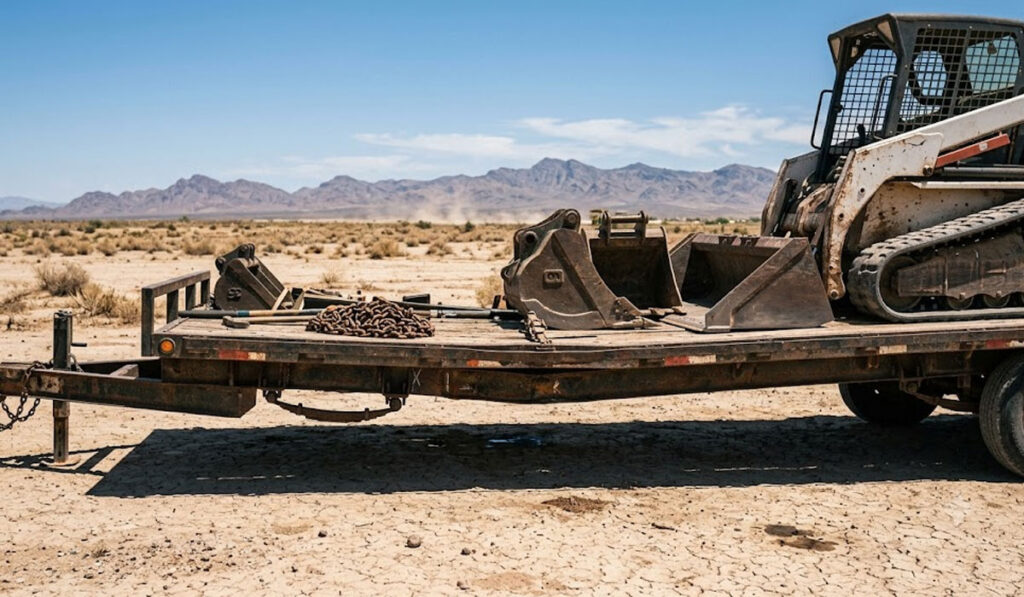
Trailer frames do not crack for no reason. A welder wants the cause, because the best-looking bead in the world will fail again if the load path is still wrong.
Overloading the trailer. Too much weight is the fastest way to turn a small flaw into a structural problem. The frame bends a little, the weld toes see more stress, and each trip adds another fatigue cycle.
The manufacturer’s certification label shows the GVWR, and that limit should not be exceeded. That label is one of the first things a welder compares against how the trailer is actually being used.
Keep heavy cargo over or just ahead of the axles, check axle and tire ratings rather than trusting the trailer GVWR alone, and inspect the frame more often if you routinely haul near the limit.
Poor welding or fabrication. Bad welds leave clues: undercut, porosity, cold lap, poor fit-up, or a repair that was simply laid over the old crack without removing damaged metal. Incomplete fusion at the root promotes cracking, and cracks in early weld passes keep propagating through later passes if they are not removed first.
That is why a good shop grinds out or gouges the bad metal before rewelding instead of stacking more on top. A weak repair often fails beside the bead, not through the middle of it, because the heat-affected zone becomes the weak area when the original cause was never addressed.
Metal fatigue, corrosion, and repeated flex. Fatigue cracks grow with use, not drama. They start small at stress risers, then open up after thousands of bumps, turns, and load cycles. Rust makes this worse because pitting acts like a row of tiny notches.
Even a solid-looking section can be thin enough near a pit that the next loaded trip restarts the crack. Look closely at weld toes, drilled holes, sharp corners, and old repair edges. If you see the same spot crack twice, assume the trailer needs reinforcement or a section rebuild, not just another bead.
Why Arizona Trailers Crack Sooner
Arizona puts stress on a trailer frame that milder climates never do. If you tow here, these are the local conditions that push a small flaw toward a full crack.
Desert heat and coating breakdown. Phoenix and the East Valley regularly hit 110 to 120 degrees in summer. The daily swing from cool nights to extreme daytime heat makes the frame, tongue, and bolted connections expand and contract, which loosens fasteners over time and works fatigue into sharp transitions like where the A-frame tongue meets the main rails.
Intense UV also breaks down paint and undercoating faster here, exposing bare steel that then rusts at stone-chip points under the frame. A car hauler stored uncovered near Mesa often shows more coating failure and weld-toe hairline cracks in five to seven years than the same trailer would in a cooler, lower-UV climate.
Off-road and overland use. Arizona towing is not all pavement. Runs up to the Mogollon Rim, out to Crown King, around Sedona, and across desert two-tracks and Forest Service roads put frames into loading they were never designed for. Uneven rock forces one wheel up while the other drops, twisting the frame rails against each other. Light utility and cargo trailers built with thin c-channel crossmembers were not engineered for that sustained twisting, so repeated trips cause weld separation and rail damage.
Dropping a loaded trailer off a ledge creates sharp vertical spikes that concentrate at spring hangers, shackle brackets, and just behind the coupler. Overlanders who add rooftop tents, water tanks, and batteries high and toward the rear raise the center of gravity and end up with diagonal cracking at the front corners and near the axle mounts.
A single-axle utility trailer that tows fine on I-10 can start cracking spring hangers and tongue gussets after a few seasons of rocky backroad use.
Monsoon season and washboard roads. From July through September, monsoon storms leave washboard corrugations and flooded washes across rural routes. Mile after mile of washboard creates rapid vertical vibration, a textbook setup for fatigue at weld toes and bolted joints, especially around suspension mounts and the tongue-frame junction.
Flooded washes and mud force water into lap joints and inside tube frames through open ends, and that trapped moisture rusts from the inside out even in a dry climate. Wash crossings also hide rocks and drop-offs that bend crossmembers, knock axles out of alignment, or kink the tongue.
Keep using it bent, and the shifted geometry pushes stress into new spots, which is how you get fresh cracking next to a previously solid weld.
Steps Welders Take to Assess the Damage
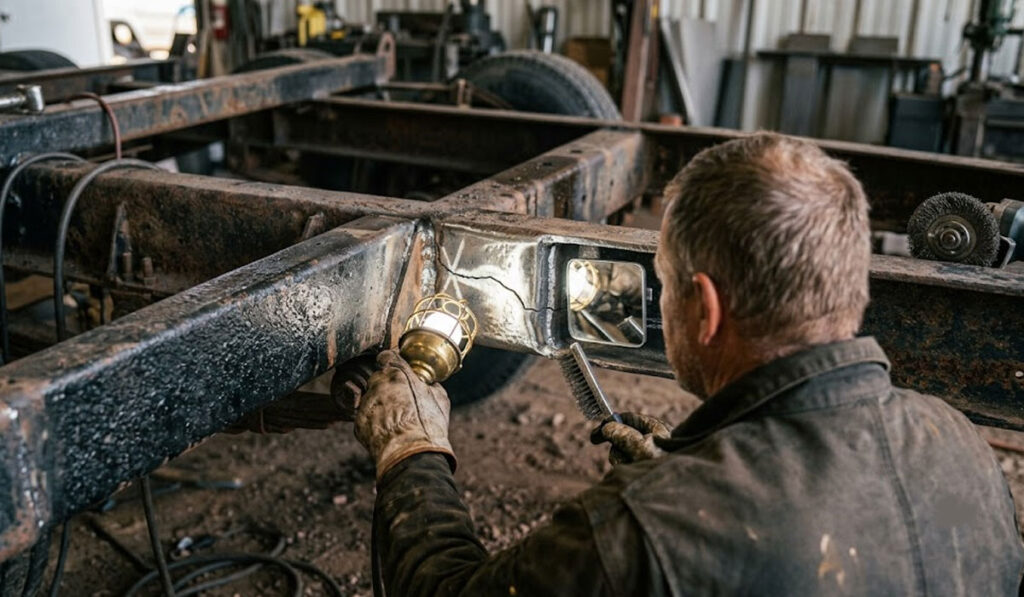
A good welder does not start by guessing the repair. They inspect, measure, and decide whether the crack is local damage or part of a bigger alignment problem.
Inspecting weld joints and stress points. The first pass is visual. Paint, undercoating, and rust are cleaned back so the welder can see the crack path and the condition of the surrounding metal. Then they check the high-stress points: weld seams, bolt holes, crossmembers, spring hangers, the axle bracket, and the transition from the tongue into the main frame.
Use a bright light and mirror to trace the crack to both ends, tap around the area and listen for a dull change in tone, measure any bend or offset before heat is applied, and inspect both sides of the member when possible, because the back side often tells the fuller story.
Choosing the right inspection method. Once the surface damage is clear, the next step is deciding how much more might be hiding. Dye penetrant testing detects surface-breaking cracks in nonporous materials; magnetic particle testing detects steel and reveals surface and near-surface damage; and ultrasonic testing locates internal cracks deeper in the joint.
The tool changes with the trailer material and the kind of damage suspected.
| Inspection method | Best use on a trailer frame | Big limitation |
|---|---|---|
| Visual inspection | Finding obvious cracks, rust bleed, bent parts, bad fit-up | Misses tiny or hidden damage |
| Dye penetrant | Hairline surface cracks on steel or aluminum | Only shows defects open to the surface |
| Magnetic particle | Steel frame welds and near-surface cracks | Does not work on aluminum |
| Ultrasonic testing | Checking for internal flaws after grinding or repair | Needs skill and good access for reliable readings |
Identifying the origin of the crack. This is the part most owners skip, and it is the part that matters most. The visible opening is not always where the failure began.
A welder traces the crack back to the sharp corner, root defect, rust pit, or loose mount that started it. If the trailer has been welded in the same spot before, they also check whether the old repair changed the stiffness of the area and pushed stress into the next section of metal.
That is why two trailers with similar-looking cracks can get very different repair plans. One may need a simple weld and light reinforcement, while the other needs section replacement, a gusset, or a larger frame repair with alignment work.
How to Prevent Trailer Frame Cracks
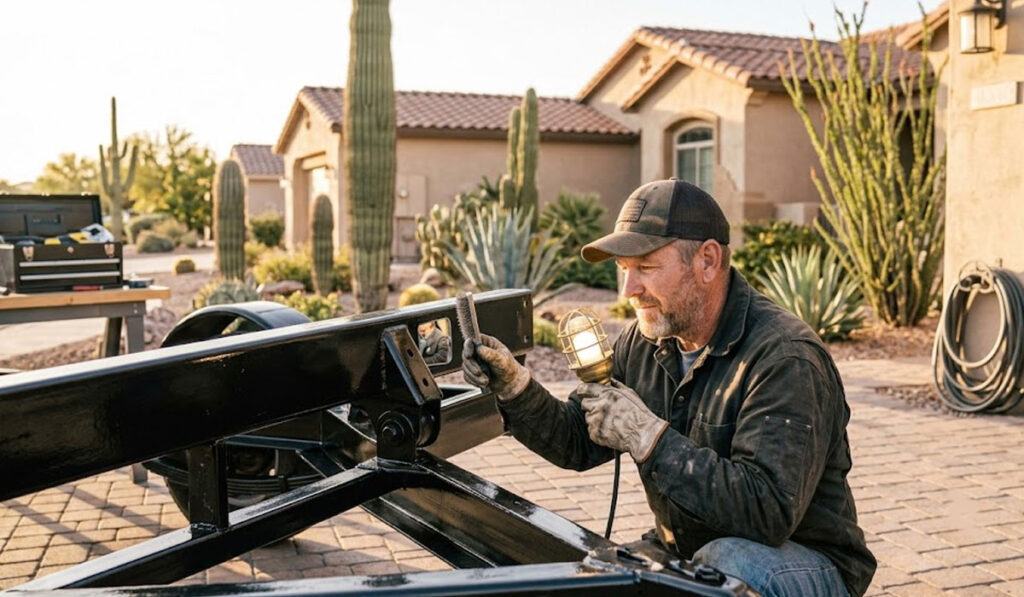
The best maintenance plan is simple: catch movement early, keep loads honest, and stop small damage before it turns into a structural repair.
Regular maintenance and inspections. You do not need a full fab shop for basic checks, but you do need a routine. Before long trips, inspect welds, seams, crossmembers, hangers, and spring mounts with a flashlight. Look for rust trails under fasteners, worn shackle holes, missing bushings, and bent brackets.
Check tire wear, ride height, and whether the trailer sits level when loaded. Verify U-bolts, shackle hardware, and wheel fasteners against the manufacturer’s torque specs. Clean and coat bare steel after any repair so rust does not start a new failure point.
A noisy suspension often warns you about frame stress before the frame itself opens up, so cracked or sagging springs, loose hardware, and worn bushings are worth fixing early. If you haul often, keep a photo log. A crack that has not changed in six months tells a different story than one that grew between two jobs last week.
Staying within safe loads. Load control saves the most money over time. Arizona follows standard highway weight limits: 20,000 pounds on any single axle, 34,000 pounds on a tandem axle, and 80,000 pounds gross for combinations with five or more axles.
Most small utility and equipment trailers run well below those numbers, but a lightly built frame carrying an uneven load near its own rating is a recipe for accelerated fatigue and bending.
There’s a compliance angle too: commercial trailers over 10,000 pounds GVWR must pass an annual DOT inspection that looks specifically for cracked welds, bent frame components, compromised crossmembers, and loose suspension brackets. If you run a work trailer hard on Arizona surfaces, it is far more likely to fail that inspection, so catching frame issues early keeps you legal as well as safe.
Good habits that protect the frame:
- Stay within GVWR and axle ratings to prevent bowed rails and cracked welds.
- Place heavy cargo near the axle centerline to reduce tongue stress and rear frame flex.
- Secure the load with rated straps or chains so a shift does not shock the frame mid-trip.
- Recheck the load after the first few miles for loose cargo or new noises at the mounts.
Get a Cracked Frame Looked at by Iron FX Welding
If your trailer frame is cracked, the right first step is not grabbing the nearest welder and burying it under a bead. It is finding the origin, checking alignment, and making sure the surrounding steel still has the strength to carry the load.
Fix the cause, use sound technique, and treat trailer safety like the priority it is.
That is exactly how Iron FX Welding approaches every cracked frame we repair in Mesa and across the East Valley. We inspect the origin, check for the misalignment that often caused the crack in the first place, remove the bad metal, and reinforce the repair so it holds up to real Arizona use, whether that means highway hauling, job-site work, or backroad and overland towing.
We handle utility, cargo, equipment, dump, horse, and off-road trailers, and we offer both shop and mobile service so we can come to your location if the trailer isn’t safe to tow.
A careful inspection now can save a much bigger repair later. If you’ve found a crack, send us a photo, and we’ll give you a straight answer.
Call or text Iron FX Welding at 480.900.1540 for a free estimate on trailer frame repair in Mesa and the East Valley.
Learn more about our trailer repair services →
Frequently Asked Questions
What does a welder check first when a trailer frame is cracked?
A welder starts at the crack itself, looking at how deep it runs and the condition of the steel and any rust around it. Then they check frame alignment, weld quality, and the load path to decide whether the damage is structural or a surface issue. The goal is to find where the crack actually started, since the visible opening is often not the true origin. At Iron FX Welding in Mesa, this inspection comes before any repair plan so the fix addresses the cause, not just the symptom.
How does a welder tell if the crack is serious?
If the crack runs all the way through the metal, the frame sags, or parts shift under load, it is serious and the trailer should not be towed until a professional inspects it. Cracks that cross a weld, run into the main beam, or sit near the coupler or safety-chain area also count as stop-towing damage. A crack in a minor non-structural bracket is far less urgent, but only an inspection can tell the difference for certain.
Can a cracked trailer frame be repaired?
Yes. Many cracks are repaired by cutting out the bad metal, cleaning and prepping the area, and welding in new plate with proper technique. A good repair also adds reinforcement, checks alignment, and confirms the load path holds. If the damage is too widespread or corrosion has thinned the steel badly, full frame or section replacement may be the safer choice. Iron FX Welding inspects the frame first and gives you an honest recommendation before any work begins.
How long does trailer frame repair take, and can I drive it after?
Small repairs can take a few hours, while larger jobs need a full day or more, plus cool-down and a final inspection. Do not tow the trailer until the welder confirms the welds and frame alignment are sound. Safety comes first, and a rushed repair on a structural crack is not worth the risk.
Does Arizona heat and off-road use really cause frame cracks?
Yes. Extreme desert heat cycles loosen fasteners and break down protective coatings, which exposes steel to rust at stress points. Off-road and washboard driving twist and vibrate the frame in ways highway towing does not, which concentrates fatigue at spring hangers, crossmembers, and the tongue. Trailers used hard on Arizona backroads commonly crack sooner than pavement-only units. Iron FX Welding sees these exact patterns across the East Valley and reinforces repairs with local conditions in mind.