
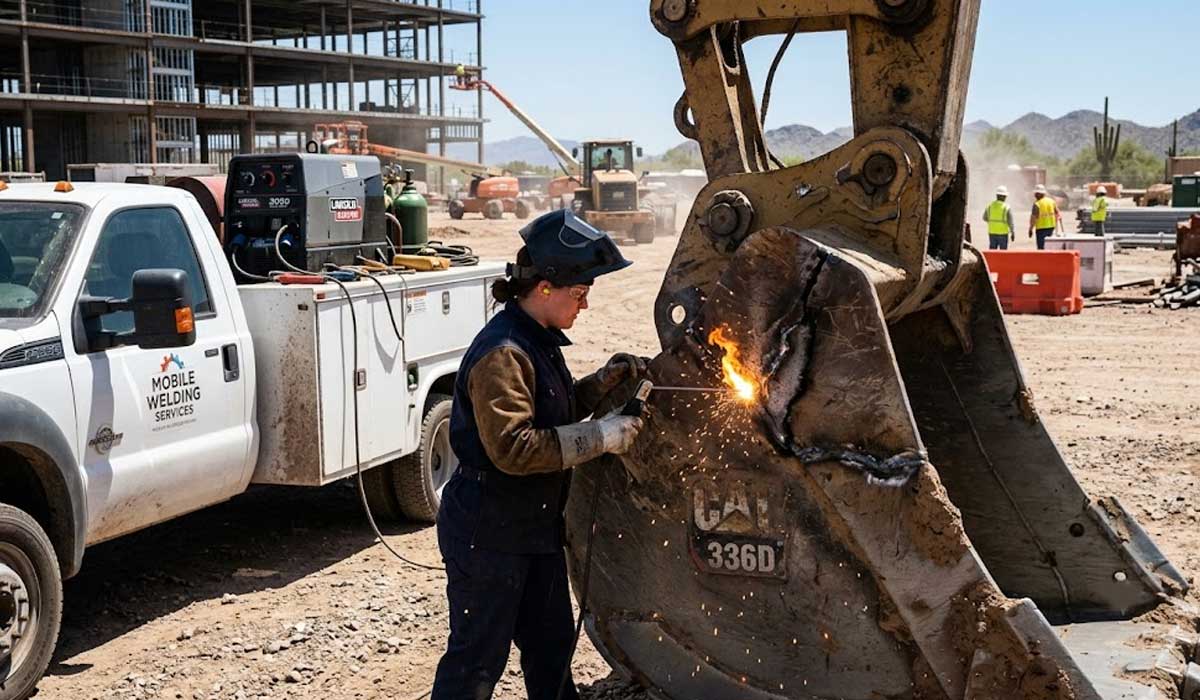
How General Contractors Use Mobile Welding to Reduce Job Site Downtime
Ever had a cracked bucket, a broken trailer tongue, or a damaged guard shut down a whole crew? That is exactly why mobile welding matters. The repair crew comes to the problem instead of sending your equipment into a shop queue, and for a general contractor, that one choice can protect the whole day’s schedule.
Iron FX Welding handles mobile welding and field repairs for job sites across Mesa and the East Valley, on heavy equipment, trailers, structural components, and support frames.
This guide covers what changes when the welder comes to you, what a real field rig actually does, and how matching the repair to the right process keeps your site moving. If you have a machine down right now, we cover how to reach us at the end.
Key Takeaways
- Mobile welding cuts downtime by bringing the repair to the machine instead of hauling damaged parts back to a shop and waiting for a slot.
- A capable field rig is a true welder and generator in one, running stick, MIG, flux-cored, and TIG plus gouging, with enough continuous power for grinders, lights, and a plasma cutter.
- The features that save the most time let the welder control the arc right at the work area, so crews are not walking back to the power source on a spread-out site.
- One mobilization can cover structural crack repair, bucket and blade hardfacing, and light fabrication, which protects labor productivity, schedules, and revenue.
- On structural work, a repair is only useful if it is documented well enough for an owner, inspector, or engineer to trust once the load goes back on.
The Real Cost of Job Site Downtime
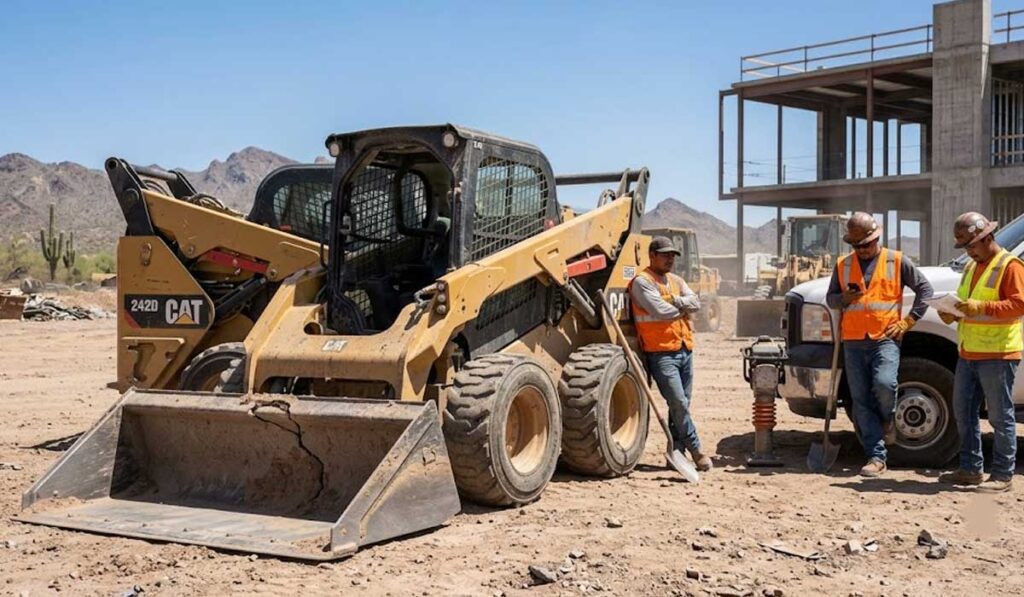
Downtime looks small on paper, but it spreads fast on a real site. One failed bracket or cracked wear edge can idle the operator, the labor around that machine, and the next task waiting behind it.
Labor makes that worse than it used to be. In the 2025 AGC and NCCER Workforce Survey, 92 percent of construction firms reported a hard time finding qualified workers, and 45 percent said labor shortages had already delayed at least one project, the top reason for delays that year.
When crews are this tight, every idle hour costs more because it is harder to reshuffle people and still hit your milestone dates.
Here is how a single breakdown spreads:
- You lose production from the down machine.
- You keep paying labor that cannot move to the next step yet.
- You may extend equipment rental, trucking, or crane time.
- You add pressure to the rest of the schedule, which can trigger overtime later.
Mobile welding shrinks that chain reaction. You repair the failed part where it sits, skip the shop backlog, and avoid the transport logistics that turn a short repair into a half-day disruption.
That applies to cracked brackets on construction equipment, damaged safety guards, worn edges on attachments, and broken mounts, and it matters just as much on the tight schedules driving the Phoenix metro build-out.
What Makes Mobile Welding Different?
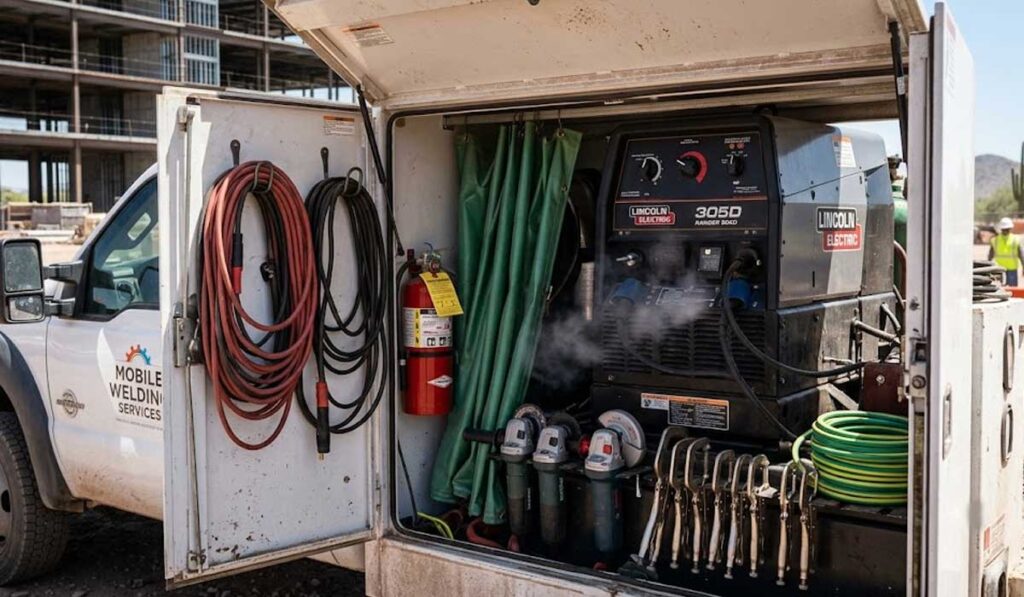
Good mobile welding is not just a shop welder on wheels. It is a field system built around power, access, arc control, safety, and fast decision-making.
On-site capability. The advantage of a strong field rig is that it is a welder and a generator in one compact package. A single machine that runs stick, MIG, flux-cored, and TIG, plus gouging, gives the crew more usable options from one truck, and continuous generator power means grinders, lights, and a plasma cutter run off the same unit.
On a crowded site, a machine that positions itself close to the repair without giving up power is worth a lot.
Adapting to site conditions. Field welding only saves time if the setup stays safe in ugly conditions. Hot-work safety standards call for inspecting the area before any cutting or welding, moving or guarding combustibles when the work itself cannot be moved, and keeping a fire watch in place for at least 30 minutes after the hot work ends. That changes how a professional crew works.
They bring welding screens, extinguishers, cable protection, ground mats, and simple weather covers so wind, dust, heat, or mud does not turn a quick repair into a safety incident or a second shutdown.
The connection is where time gets lost. If the work clamp is hot, muddy, or too far from the joint, you are already losing time. Long leads, dirty clamps, damaged crimps, and undersized cables all raise resistance in the weld circuit, which creates voltage drop, an unstable arc, and rework that should never have happened.
Experienced field welders clean the connection point first, size cables for the full out-and-back circuit, and carry backup leads instead of pushing through a weak setup. The best rigs also let the welder adjust settings right at the work area rather than walking back to the machine, which matters when leads run across a slab, up structural steel, or under a piece of heavy equipment.
Common On-Site Repairs with Mobile Welding
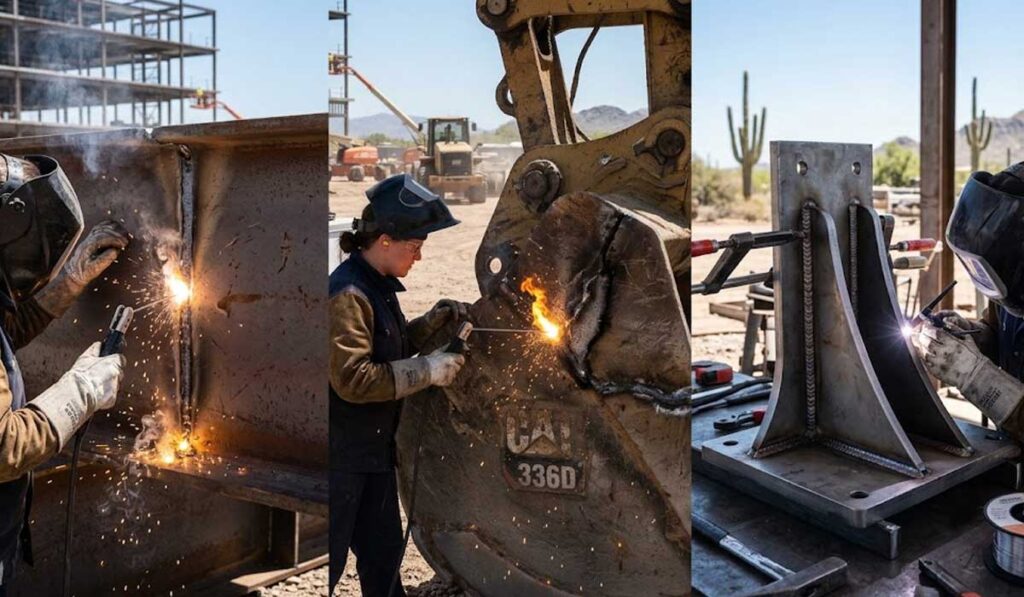
Most downtime calls land in a few repeat categories. Match the repair to the right process and tooling, and you cut wasted trips and give the machine a better shot at returning to work the same day.
Structural crack repairs. Cracks in beams, plates, brackets, and other structural components need more than a quick bead. The repair has to match the base metal, joint design, and load path, which is why written procedures and qualified welders matter on structural work.
A written welding procedure specification records the controllable variables used on the joint, and welds deposited outside that procedure may not deliver the properties the part needs. In plain terms, a fast repair is only useful if the owner, inspector, or engineer can trust it once the load goes back on.
- Remove damaged metal and clean the joint fully before anyone strikes an arc.
- Use the process that fits the repair and the access. Stick welding remains a field favorite, while flux-cored and MIG speed production where shielding and positioning allow.
- Document the repair with photos, consumables, and inspection notes so sign-off does not become the next delay.
One useful checkpoint for structural steel under AWS D1.1: prequalified procedures exist for stick (SMAW), submerged arc (SAW), flux-cored (FCAW), and standard spray or pulsed MIG (GMAW), but short-circuit MIG and TIG (GTAW) are not prequalified and require a qualified procedure backed by testing.
That matters before anyone assumes the fastest-looking process is the compliant one.
Bucket and blade restoration. Bucket lips, dozer blades, cutting edges, and wear corners fail for different reasons, so the best repair is not always the hardest weld metal you can buy. Wear falls into categories like severe impact, abrasion plus impact, and metal-to-earth abrasion, and each one calls for a different strategy.
Smart equipment repair usually starts with build-up and alignment, then finishes with hardfacing only where the part actually wears. Hardface the whole part without accounting for impact and you can create a surface that chips instead of lasting longer.
| Wear pattern | Common field example | Best mobile repair move |
|---|---|---|
| Metal-to-earth abrasion | Loader buckets and grading edges in soil or aggregate | Rebuild the profile first, then hardface where material flow wears most |
| Abrasion plus impact | Excavator buckets and quarry attachments seeing rock and shock load | Use a tougher deposit under the wear layer so the surface resists chipping |
| Severe impact | Hammered corners, adapters, and strike zones | Favor crack-resistant build-up alloys and controlled cooling over maximum hardness alone |
This is one area where on-site welding has a clear cost edge. You restore the worn zone, replace teeth or wear plates, and send the machine back to work without loading the attachment onto a trailer and waiting for shop space.
Custom modifications and fabrication. Field fabrication is where mobile welding earns its keep for a GC. You add brackets, gussets, patch plates, ladder mounts, hose supports, and simple metalwork the same day the need shows up.
Aluminum takes a different approach than carbon steel, because it pulls heat away several times faster and is more prone to warping, burn-through, and lack of fusion if the operator runs steel settings and pace.
- For aluminum, remove the oxide layer first with a stainless steel brush. Skipping that prep invites porosity.
- Use a push technique instead of a drag on MIG aluminum work, since dragging can trap contamination and create pinholes.
- Choose a spool gun or push-pull setup when possible, because aluminum wire can birdnest in a standard setup and turn a simple fix into a refeed job.
A rig that can switch from carbon steel brackets to aluminum work without a full reset protects the schedule and reduces repeat mobilizations.
Benefits of Mobile Welding for General Contractors
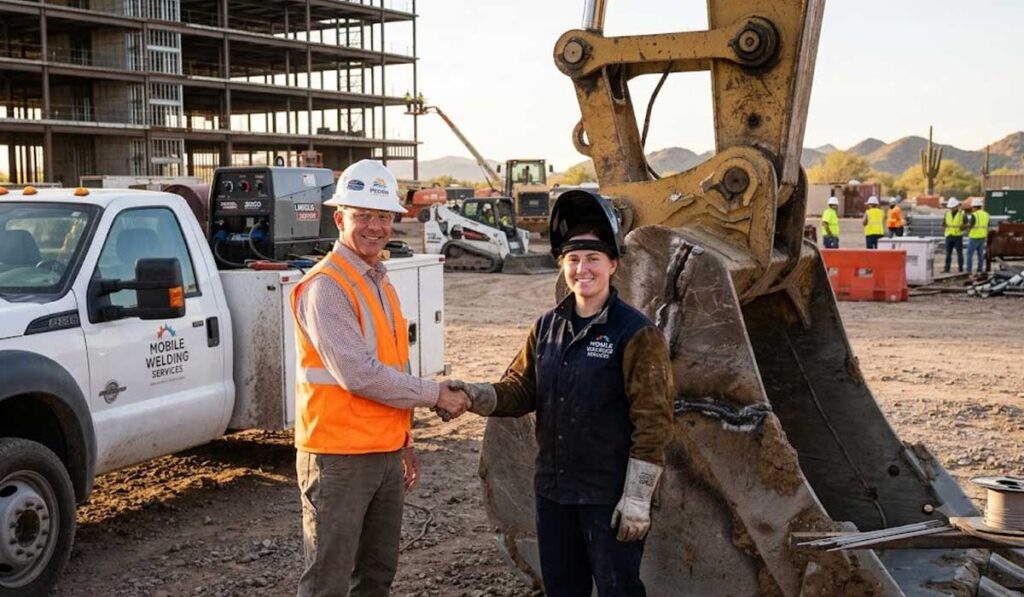
The biggest win is simple: fewer handoffs. You keep the repair, the decision maker, and the affected machine in one place, so downtime stops spreading across the site.
Minimized equipment transport. Hauling damaged equipment off site creates its own queue: a lowboy, loading labor, staging space, unloading time, then another trip to bring the asset back. Mobile welding removes most of that. The machine stays where it failed, the damaged assembly gets repaired in place, and the rest of the job keeps moving.
You cut trucking, fuel, and handling costs, avoid extra crane or forklift picks just to move a repairable part, lower the chance of adding damage during loading, and keep the operator close so testing and restart happen fast.
Faster response. A strong mobile rig shows up ready to weld, cut, grind, and generate power. That matters because the slow part of a repair is often not the bead, it is the setup, the adjustment trips, or the missing feeder or consumable that turns one job into two calls.
Faster response is not only about how fast the truck arrives. It is about arriving with the right power, the right feeder, and a repair plan so the first pass is the productive one.
Reduced project delays. Schedules get tighter when labor stays tight, and idle crews are harder to absorb than they were a few years ago. The right field welder protects more than a repair budget.
It helps preserve labor productivity, hold down rental overrun, and keep milestone dates from slipping after a breakdown.
| Delay source | What mobile welding changes |
|---|---|
| Broken bucket, blade, or guard | The repair stays on site, so the machine can often return to service the same shift |
| Trailer or support frame failure | Field fabrication lets crews brace, patch, or replace damaged steel without waiting on shop space |
| Equipment bracket or mount damage | The welder rebuilds mounts, adds reinforcement, and coordinates with mechanics in one mobilization |
| Voltage drop and rework on long leads | Arc-side control and proper cable setup stabilize settings and reduce repeat passes |
That is the real return. You do not just fix a broken part, you keep the rest of the project from waiting on it.
Keep Your Job Site Moving with Iron FX Welding
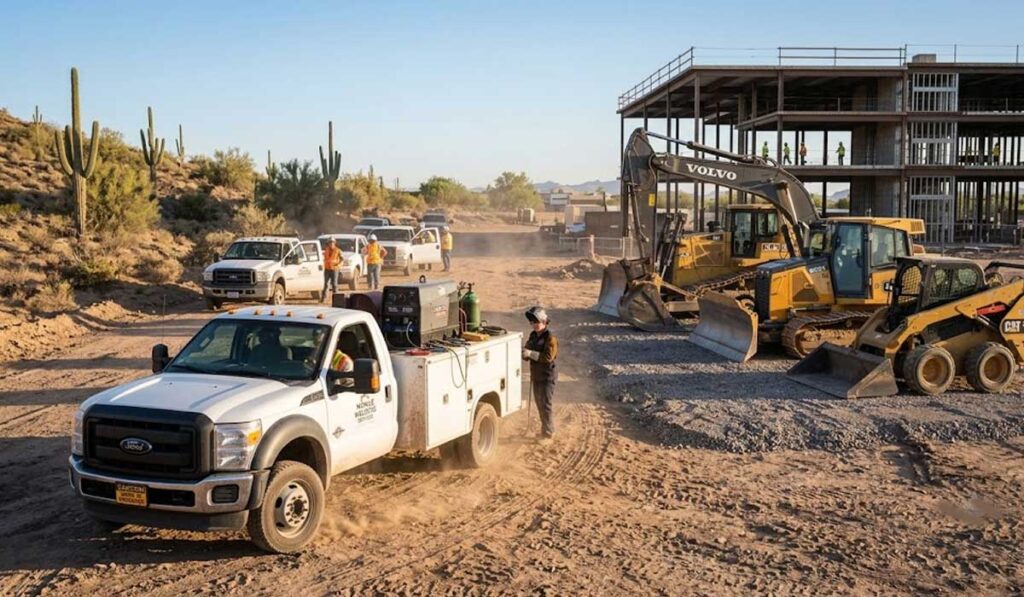
Mobile welding is one of the fastest ways to cut downtime without cutting corners. You keep the machine on site, match the repair to the right process, and get your crew back to productive work sooner.
That is what Iron FX Welding does for general contractors across Mesa and the East Valley. We come to your job site with a field-ready rig, assess the failure, and handle structural crack repair, bucket and blade restoration, and custom fabrication in a single mobilization.
We work to process what the repair actually calls for, follow job-site hot-work safety, and document structural repairs so sign-off does not become your next holdup. When a machine or a frame goes down, the goal is the same: back in service, on schedule.
If you have equipment down or a repair that is threatening your timeline, call us and we will tell you how fast we can be on site.
Call or text Iron FX Welding at 480.900.1540 for on-site welding across Mesa and the East Valley.
See all our mobile welding services →
Frequently Asked Questions
What is mobile welding for general contractors?
Mobile welding brings welding and light fabrication directly to the job site, so a general contractor gets on-site repairs and custom parts without hauling steel or equipment to a shop. Iron FX Welding shows up to your Mesa or East Valley site with a field rig, then repairs the failed part, fabricates what is needed, and gets the machine or structure back in service. It covers heavy equipment, trailers, structural components, and support frames.
How does mobile welding reduce job site downtime?
It removes the shop queue and the transport time. Instead of trailering a damaged machine off site and waiting for a repair slot, the welder fixes the part where it sits, often the same shift. That keeps the operator, the surrounding crew, and the next task from stalling behind one breakdown. With construction labor tight, avoiding that idle time is a real schedule and cost saver.
When should a general contractor call a mobile welder?
Call for emergency repairs, field fabrication, or any time a machine, bracket, or beam fails and the schedule is at risk. Reaching out early keeps a small crack or a torn mount from becoming a bigger structural repair later. Iron FX Welding responds to job-site calls across the East Valley, so a down machine does not have to wait on shop availability.
Can you handle structural repairs that need to pass inspection?
Yes. Structural repairs have to match the base metal, joint design, and load path, and they need documentation an owner, inspector, or engineer can trust once the load returns. Iron FX welds structural repairs to the correct process, follows AWS D1.1 practice where it applies, and documents the work with photos, consumables, and inspection notes so sign-off does not slow you down.
What does a mobile welding crew bring to the site?
A capable crew arrives with a welder and generator in one, cutting and grinding tools, clamps and fixturing, backup leads, and job-site safety gear like screens, extinguishers, and cable protection. That setup lets them handle fit-up, welding, and finish work in one visit rather than making a second trip for a missing consumable or tool.